ADHD accommodations at work that actually help
ADHD accommodations at work are useful, and they only reach the one person who goes through the process to ask. This page covers what The Right Room says about formal accommodations, everyday adjustments that help a whole team, and tools you can start using tomorrow.
By Racheal Pallares, author of The Right Room. 5-minute read.
The short answer
The ADHD accommodations at work that help most start with finding where the cognitive load comes from. Support a formal accommodation when someone needs one, and add everyday adjustments that make the room work for everyone.
On this page
What counts as ADHD accommodations at work?
Search for ADHD accommodations and most of what comes back was written for classrooms. Work is a different room. In The Right Room I separate two things that usually get lumped together: accommodations and adjustments.
Accommodations are real and useful, and sometimes necessary. They help a specific person in a specific situation work in an environment that wasn’t built for them. They also come with a process. They require disclosure and a two-way conversation between that person and their employer about a specific need. Under the Americans with Disabilities Act, an employer can typically ask for documentation of a disability and how it limits you before granting an accommodation, unless the disability or the need for it is already obvious. That process exists for good reason.
Adjustments change the environment for everyone. Think of an agenda sent the night before, or a written confirmation after a verbal meeting. Nobody has to disclose anything, and nobody gets singled out. The room simply works better for more people at the same time.
“Accommodations help the few. Adjustments help everyone.”
From Chapter 28, Accommodations vs. Adjustments
Why does a list of workplace accommodations for ADHD fall short?
People ask me for the list all the time. The checklist you can hand to HR before a new hire starts. I don’t give out that list, and the reason matters.
An accommodation addresses the problem for one person without changing the system that created it. The employee who gets permission to work from home because the open office is overwhelming is being helped. The open office is still there, and everyone else is still in it. The next person who struggles in that space has to go through the same disclosure process to get the same individual patch.
Flexibility shows this clearly. Everyone agrees it helps. Does it mean coming in late, core hours with open schedules around them, or working whenever you want as long as the work gets done? What works in a creative agency may be unworkable in a hospital or on a manufacturing floor. A list can’t know the environment it lands in, and a poor fit can create resentment and the impression that support is a set of special privileges.
So the best workplace accommodations for ADHD start with understanding the problem. Where is the cognitive load coming from? What is the collision between how this person processes and how this environment operates? That conversation has to happen between real people about a real situation.
What helps with focus at work?
Focus is where most requests for ADHD accommodations at work begin. Sustained attention is a neurological process regulated mainly by dopamine, which acts as an engagement signal. It answers one question for your brain: does this task have enough reward to keep going? In ADHD brains, lower dopamine receptor availability makes that signal less consistent. Explaining why the task matters or adding pressure won’t change it.
“The brain doesn’t sustain attention because something is important. It sustains attention because something is engaging.”
From Chapter 9, Sustained Attention
I teach four levers for this: interest, novelty, urgency and challenge. I hate Excel spreadsheets, and one report finds me every month. Some months I take my laptop to a coffee shop or a library. Other months I try to finish faster than last time, or add a formula that wasn’t in last month’s version. The spreadsheet didn’t change. My relationship with it did.
Motivation gets someone into a task. Momentum keeps them there, and momentum is protected on the calendar. Hold real blocks of time, and build a team norm that a closed door or a status light means come back later unless it’s genuinely urgent. Body doubling helps here too: two people on a video call, each working on their own thing, no talking required.
Two more tools come from the burnout chapters. Mechanical outsourcing gets information out of your head, because if it isn’t written down in one place, it doesn’t exist. I went from hundreds of Post-It notes to one note card per meeting. Sensory dampening lowers what your system has to process, with noise-canceling headphones, softer light, and notifications off while you work.
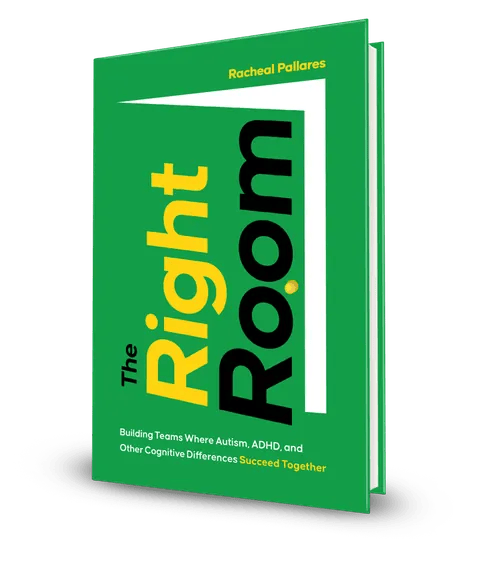
This comes from Chapter 28, Accommodations vs. Adjustments.
The Right Room goes further, with the stories and tools behind it.
How do you ask for what you need?
You don’t need anyone’s permission to change how you work. Most of the tools above are yours to put in place tomorrow morning, with no announcement and no formal request. When you do need something from someone else, keep it small. One sentence instead of a speech. You don’t have to name a diagnosis or explain your neurology. Just say what you need.
Try this
- Ask for writing: “I process better in writing. Can you send me a summary after this call?”
- Ask for a real deadline: “I work better with a clear deadline than an open-ended timeframe.”
- Set a response window and say it out loud: “I check messages at nine and two.”
- Protect a focus block: “Can I protect Tuesday mornings for focused work?”
- Pick one standing time for body doubling with a coworker on a video call.
None of those sentences mention neurodiversity or require a diagnosis. They give the people around you a user manual for getting your best work. If an explanation doesn’t land, talk about the outcome instead: “I do my best work when I have the agenda in advance, the output is better.” And watch how your manager handles other people’s vulnerabilities before you share your own. Start with one low-stakes sentence and see what happens.
What should managers do about accommodations for autism and ADHD?
Start by looking for where cognitive load is highest on your team right now, where the system creates friction the work itself doesn’t require. That’s where an adjustment will have the most impact.
Have the conversation before anyone needs the accommodation. Asking whether now is a good time before you hand someone something new costs nothing. The three questions from Chapter 5 are a good beginning: How do you prefer to communicate? What’s the hardest part of tasks for you? What do you need to do your best work? In your next one-on-one, you can also ask which of the four attention levers helps each person stay in a task once they’ve started.
When someone does need formal ADHD accommodations at work, support them through it. Know your company’s process, and know the ADA well enough to explain it. Be the manager who makes that conversation feel safe for the person having it.
Accommodations and adjustments serve different moments. Knowing which one a situation calls for is the skill, and it gets better every time you practice asking the right questions.
Questions about ADHD accommodations at work
What is the difference between an accommodation and an adjustment?
An accommodation helps one specific person with one specific need, and it usually requires disclosure and a formal process with the employer. An adjustment changes the environment for everyone, like sending the agenda in advance or confirming verbal decisions in writing. The book’s short version: accommodations help the few, and adjustments help everyone.
Do I have to disclose ADHD to get support at work?
A formal accommodation requires disclosure, and the book notes that under the ADA an employer can typically ask for documentation. Many tools need no disclosure at all. Written summaries, response windows, focus blocks and body doubling can be requested in one plain sentence. Your company’s process and the ADA itself are the places to check the formal details.
What helps people with ADHD focus at work?
The book points to four levers that turn the attention signal back on: interest, novelty, urgency and challenge. It also recommends protecting momentum with blocked time, a team norm about closed doors or status lights, and body doubling. Writing things down in one place and reducing noise, light and notifications lowers the load on working memory.
How do I ask my manager for ADHD accommodations?
Keep it to one sentence and name the need, like “I work better with written instructions, can we do that?” If it doesn’t land, frame it around the outcome. Before sharing more, watch how your manager treats other people’s vulnerabilities, and build trust in small pieces. For a formal accommodation, follow your company’s process.
More questions this book answers
How to manage employees with ADHD
How to work as a team with ADHD
The ADHD manager: leading with ADHD and leading people who have it
Start with Chapter 1. It’s free.
The Recess Room, straight to your inbox.

