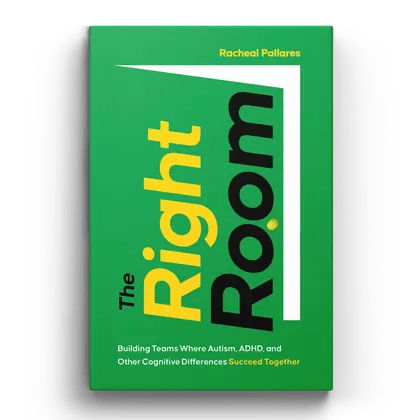
The book on managing employees with ADHD and autism
The Right Room
Building Teams Where Autism, ADHD, and Other Cognitive Differences Succeed Together
By Racheal Pallares. November 11, 2026. Hardcover, paperback and Kindle.
How do I manage employees with ADHD and autism?
Most workplaces were built around assumptions nobody thought to question: that instructions should be understood the first time, that meetings work the same way for everyone, that distractions can simply be ignored, and that professional behavior has one recognizable form.
But human brains don’t work that way.
For employees with ADHD, autism, and other cognitive differences, ordinary workplace practices can create friction that we mistake for poor performance, disengagement, or lack of fit. When the system goes unquestioned, the employee usually gets blamed.
In The Right Room, Neurodiversity Training Institute founder Racheal Pallares shows us how to recognize when the problem may be the environment rather than the person.
Drawing on organizational psychology, years of work with neurodivergent professionals and managers, and her own experience with ADHD, Pallares examines how communication, meetings, expectations, job design, and team culture can either consume people’s energy or allow them to do their best work.
Rather than diagnosing employees, we need to understand where workplace systems create unnecessary barriers and how small, practical changes can help different kinds of minds do their best work together.
Questions this book answers
If you’ve typed one of these into a search bar, this book was written for you.
How do I manage employees with ADHD?
Start with the friction, not the person. Chapter 10 (Task Initiation) shows why starting is often the hardest part and gives you the Zero Step: one physical action, under thirty seconds, no decisions. Chapter 14 (Working Memory) and Chapter 18 (Feedback) cover the other two places managers get stuck most.
What do autism and ADHD look like at work?
Part 2, The Friction Points, walks through thirteen of them: sustained attention, masking, last-minute changes, emotional regulation, stimming and more. Each one shows what it looks like from both sides of the desk.
How do I work as a team with ADHD?
Chapter 13 (Double Empathy) explains why communication breaks down in both directions, and Chapter 15 (Last-Minute Changes) shows what to do when the plan moves. Part 3 speaks directly to everyone in the room.
What ADHD accommodations actually help?
Chapter 28, Accommodations vs. Adjustments, explains the difference and why most of what helps needs no paperwork, no diagnosis and no approval.
I’m an ADHD manager. Where do I start?
Chapter 22 (Manager Capacity) and Chapter 20 are written for you, including tools you can use for yourself without telling anyone.
How do I train employees with ADHD?
Chapter 7 (Top-Down vs. Bottom-Up Processing) shows why the same instructions land differently for different brains, and Chapter 14 (Working Memory) shows how to hand off information so it sticks.
How do I manage neurodiversity on my team?
Chapter 5, Change the Culture, Change the Room, shows why you don’t need a company program to start. You control the culture inside your team.
How do I build a high-performing team with different kinds of minds?
Chapter 29, The New Operating System, pulls it together: small, specific changes that cost almost nothing and let everyone do their best work.
Pick your format
All three launch November 11, 2026
Hardcover
With dust jacket. Made for your shelf and for gifting.
Paperback
The easy one to carry, mark up and pass along.
Kindle
Adjust the font and size to read the way that works for you.
Buying 10 or more copies? Your team gets a free one-hour Q&A with Racheal.
Managing neurodiversity at work, in 29 chapters
Each chapter stands on its own. Skip straight to the one that matches what is happening on your team, or in your own head, right now.
Opening
- The Recess Room
Part 1: Foundation
- It All Started with Pizza
- The Standard Brain Doesn’t Exist
- The Coffee Pot Is Empty
- Change the Culture, Change the Room
- The Boxes
Part 2: The Friction Points
- Top-Down vs. Bottom-Up Processing
- Monotropism
- Sustained Attention
- Task Initiation
- Remote Work
- Masking
- Double Empathy
- Working Memory
- Last-Minute Changes
- Emotional Regulation
- Stimming and Fidgeting
- Feedback
- A Strong Sense of Justice
Part 3: All Sides of the Room
- For Neurodivergent Professionals
- For You, the Neurotypical Reader
- Manager Capacity
- The Kind, Compassionate Manager
Part 4: Occupational Burnout
- What Is Occupational Burnout?
- How to Get Out of Occupational Burnout
- Changing the System of Burnout
Part 5: Closing
- Conflicting Needs
- Accommodations vs. Adjustments
- The New Operating System
What early readers are saying
“Racheal Pallares shines a light on the effort that can go unseen in everyday working life, and reminds us to ask people what helps them do their best work rather than assume a diagnosis gives us the answers.”
Jayne Fox
ADHD Coach and Neurodiversity Educator, New Zealand
“Finally, a book that gets past awareness. I have read a shelf of books that explain autism and ADHD. This is the first one that showed me how they actually show up at work, in the meeting that changed at the last minute and the shirt nobody thought twice about handing out, and then told me what to do about it.”
Felicity Smith
CEO and former head of talent at a Fortune 500
“The Right Room courageously explores the importance of shifting our workplaces to one that enables human capability for the future.”
Tara Langan
Founder, Career TLC, Canada

About Racheal Pallares
Racheal Pallares is a human systems designer who has spent her career designing work around cognitive differences, including autism and ADHD. She has led multi-year workforce redesign for public agencies, developed managers inside the Fortune 500, and is the author of The Right Room (November 2026). When she’s not working, you can find her around Pittsburgh, floating down the river, hiking, baking, and entertaining friends and family.

