How to train employees with ADHD
Knowing how to train employees with ADHD starts with how you hand over information. When training breaks down, the gap is usually in the delivery, and the person was ready to learn the whole time.
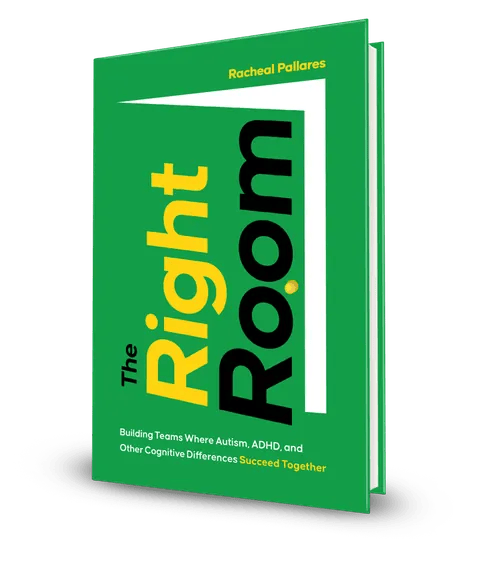
By Racheal Pallares, author of The Right Room. 5-minute read.
The short answer
How to train employees with ADHD: put every instruction in writing, tie tasks to cues, define what done means, and help each person find their first step.
On this page
Why does training employees with ADHD so often go sideways?
In my book I tell a story about a coffee pot. Mark has a career-changing client meeting at two. At one o’clock he finds the pot empty, announces it to the room, and walks away. Forty-five minutes later it is still empty, and he wants to know why nobody made a fresh pot.
Alex, a high-performing professional with an ADHD brain, heard him. Her brain filed his comment as background information, the same way it would file someone saying the elevator is slow today. Nobody asked her to do anything. No task was assigned and no owner was named. To Mark, the signal was obvious. To Alex, there was no signal at all.
That moment is a small version of what happens in a lot of training. Research shows a task needs something to keep it in mind for an ADHD brain, like a deadline or a direct ask. Without that hook, it gets filed as background. Then the trainer decides the new hire is unreliable, when the instruction never arrived in a form their brain could hold.
So when training employees with ADHD isn’t working, look at the delivery first. Nothing is wrong with the person. The signal was unclear.
How to train employees with ADHD so instructions stick
Working memory is the mental notepad. It holds about four things at once, on average, and that’s everyone’s number. For people with ADHD and autism, those four slots run short most days. Stress and a bad night of sleep eat into it further, and so does the flood of new information that comes with any first week.
That makes verbal-only training the biggest risk. A new hire hears three things in a meeting and walks back to their desk holding the first one. The rest fade before they sit down. They do the part they have, and from the outside it looks careless.
“The most expensive thing in most workplaces is verbal-only instruction.”
From Chapter 14, Working Memory
Write it down and make it visible. After any conversation where you assign work, send a quick message about what was discussed, who owns what, and when it’s due. That message is a retrieval cue delivered in advance. It takes thirty seconds to send.
Then turn time-based asks into event-based ones. “Remember to send this by three” asks a brain to fire on a clock with nothing in front of it. “Send this right after your two o’clock” gives the same deadline with a cue attached. Keep the work on a board or a list that stays open in the daily line of sight. Out of sight is out of mind for more people on your team than you realize.
This comes from Chapter 14, Working Memory.
The Right Room goes further, with the stories and tools behind it.
Should you teach the big picture or the details first?
Every brain builds its picture of the world from a direction. Top-down processors start with the outcome and fill in the gaps. Bottom-up processors need the details verified before they can trust the outcome. ADHD doesn’t sort neatly into either one. The research ties it to inconsistent top-down regulation, which makes the brain more open to interruptions and more variable in how it moves between the two.
That matters when you’re teaching new tasks to people with autism and ADHD, because trainers tend to teach in their own direction. A top-down trainer gives three sentences and expects execution. A bottom-up trainer sends a twelve-page pre-read before a thirty-minute check-in. Both versions feel complete to the person giving them.
Ask each new hire what they need first. Give people who need structure the logistics ahead of time. Lead with the outcome for people who need the big picture. And define what done means before the work starts, so both processing directions are working toward the same finish line.
What if a new employee understands the task and still can’t start?
That’s task initiation, the moment work moves from still to active. It’s managed by the prefrontal cortex, the same executive system at the center of ADHD, and it gets harder under cognitive load. A new job is heavy on load. The person knows the work and can do it. The starting point just doesn’t fire on its own.
Most managers respond by starting the task for them. It feels like leadership, and over time it makes the manager the starting point for everything. Work stops moving until the manager touches it.
I have my own version of this. There’s a monthly spreadsheet I have updated for years, and I will still do anything to avoid it. So I talk myself through the first thirty seconds: open the document, find last month’s tab, add a new one, name it for the month. Getting to the tab is the entire problem. Everything after that, I can do. I call it my Zero Step.
When you train someone, ask for their Zero Step instead of handing it to them. “What’s the first action that gets this moving?” Then add the Five-Minute Rule, where the only requirement is five minutes with the task. Over time, people start arriving with their own starting point already picked.
How direct should you be when onboarding employees with ADHD?
More direct than feels natural to most of us. In the book, a manager named Sarah asks her analyst Mark, “when you get a chance,” to “maybe tighten up” some slides. He processes language literally, so he hears an optional suggestion and goes back to his main work. On Friday the slides are unchanged, and both of them are upset for reasons the other can’t see.
“You can be completely kind and completely explicit at the same time. Direct isn’t mean.”
From Chapter 13, Double Empathy
Replace the hint with the explicit ask. “I need the formatting on this report updated by three today so the client can read it easily. Is anything blocking you from hitting that deadline?” Nothing is left to guess, and there’s an open door to flag a problem.
Onboarding employees with ADHD also goes better when you name your communication style early and ask for theirs. Research I cover in the book found that information gets lost when two different processing styles talk without a bridge, and that the gap closes when people know each other’s channel in advance. That conversation takes about thirty seconds.
Try this
- Follow every verbal assignment with a short written message: what was discussed, who owns it, when it’s due.
- Anchor deadlines to events, like “right after your two o’clock” instead of “by three.”
- Define what done means before the work starts.
- When a task stalls, ask two questions: “Do you have your Zero Step? Have you given it five minutes?”
- Say the explicit ask with a deadline and a reason, then ask what might get in the way.
Every one of these changes helps the whole team, including the people who never mention ADHD at all. The busier the season, the more your team needs them.
Questions about training employees with ADHD
What is the best way to give instructions to an employee with ADHD?
Say it, then put it in writing where they can see it. Send a quick message after the conversation with what was discussed, who owns what, and when it’s due. Tie deadlines to something already on their calendar. Working memory holds about four things at once for everyone, and for people with ADHD those slots run short most days.
Why does my employee with ADHD forget tasks from meetings?
Often it’s a retrieval problem called cue-dependent forgetting. The information is still there, waiting for the right cue to bring it back. A task assigned only out loud has no visual anchor, so once the meeting ends it can drop out of sight completely. A written follow-up gives the cue back before anything slips.
Is it rude to be very direct with employees with ADHD?
No. Direct isn’t mean. A soft hint can feel polite to the person saying it and leave the listener guessing at what matters. A clear ask with a deadline, a reason, and an open door to flag problems is kinder, because it gives people the context they need to do their best work.
What if a new hire with ADHD keeps stalling before starting tasks?
Treat it as a starting problem, since motivation doesn’t solve it. Ask for their Zero Step, one small physical action that takes under thirty seconds, like opening last month’s file. Then ask for five minutes with the task. Keep guiding without taking the task over, and the starting point gradually moves from you to them.
More questions this book answers
How to manage employees with ADHD
The ADHD manager: leading with ADHD and leading people who have it
How to work as a team with ADHD
Start with Chapter 1. It’s free.
The Recess Room, straight to your inbox.

