How to manage employees with ADHD
Learning how to manage employees with ADHD starts with the structure around the work. These tools from The Right Room help people with ADHD get started on their own and hear feedback the way you meant it.
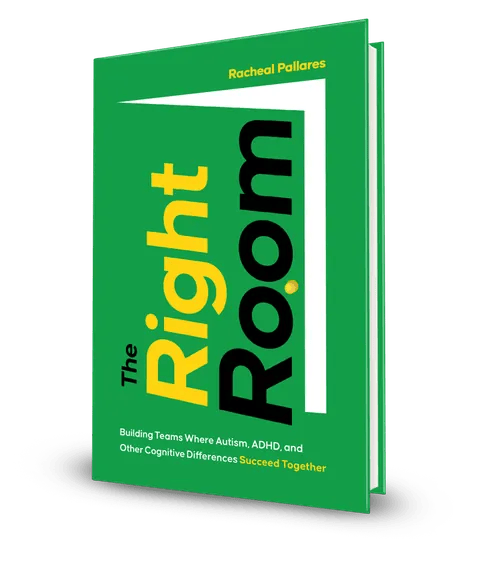
By Racheal Pallares, author of The Right Room. 10-minute read.
The short answer
The answer to how to manage employees with ADHD is to build support into the work itself. Give tasks a clear first step and written cues, and time your feedback so it can land.
On this page
- Why do the usual moves fall flat when managing employees with ADHD?
- How do you help an employee with ADHD get started on a task?
- What helps an employee with ADHD stay focused?
- What helps when an employee with ADHD keeps forgetting tasks?
- How should you give feedback to an employee with ADHD?
- What should you do when plans change at the last minute?
- What if an employee with ADHD reacts strongly to something small?
- How to manage employees with ADHD without becoming their starting point
If you are trying to work out how to manage employees with ADHD, you have probably explained the task again and checked in more often. Those moves come from a good place. They also leave you carrying more of the work. In The Right Room, I look at the room first. The people on your team are capable. The structure around the work is usually what needs to change.
Why do the usual moves fall flat when managing employees with ADHD?
Mark had a career-changing client meeting at two o’clock. By one, he needed his afternoon coffee. He walked into the kitchen, found the pot empty, announced it to the room and walked away. Forty-five minutes later the pot was still cold, and Mark wanted to know why nobody had made a fresh one.
Alex looked up, genuinely confused. “When you said the pot was empty, was that when we were supposed to know?”
Alex has an ADHD brain, and she had heard him. Her attention fires in every direction at once, so she filters incoming information all day just to stay in her work. A peer thinking out loud, with no direct ask and no name attached, got filed as background. No task was assigned. No owner was defined. To Mark, the signal was obvious. To Alex, there was no signal at all.
Then Mark wrote that moment into how he saw her: unreliable, has to be managed. Alex had no idea it was happening. A lot of what gets labeled “gets distracted” in a performance review starts right here, with two people reading the same moment two different ways.
A better first step in managing employees with ADHD is an honest conversation. The book suggests four questions: How do you communicate best? What helps you focus? What do you need to do your best work? Where does the system get in your way? Ask the whole team, and keep coming back to it. Most people have never been asked.
How do you help an employee with ADHD get started on a task?
Task initiation is the moment work moves from still to active. For many people with ADHD, the next step doesn’t trigger on its own. They understand the work and they can do it. The start just doesn’t fire, and from the outside it looks like avoidance.
I have a monthly spreadsheet I will do almost anything to avoid. I have pulled laundry out of the dryer the second the buzzer went off. During one bad stretch I got good enough at sourdough bread that people asked me for the recipe. I know exactly what goes in that file. The hard part is the moment right before it.
So years ago I wrote myself a script for that moment: open the document, find last month’s tab, add a new one, name it for the month. I call it my Zero Step. Getting to the tab is the entire problem. Everything after that, I can do.
The Zero Step is one small physical action, under thirty seconds, with no decisions required. It is only the first push, with no checklist of the whole process. For a quarterly report, it might be opening last quarter’s report and renaming it. When you manage an employee with ADHD, start asking for it instead of handing it over: “What’s your Zero Step? What’s the first action that gets this moving?” If they hesitate, narrow it without taking it over. What can they open, rename or pull in the next thirty seconds?
Pair it with the Five-Minute Rule. The only requirement is five minutes with the task. When a task feels open-ended, the brain treats it as high cost and looks for an exit. Five minutes shrinks that cost enough for the brain to engage, and once the work begins, even small progress changes how it feels.
Your follow-up changes shape too. Instead of asking why something isn’t done, ask the two questions that trigger a start: “Do you have your Zero Step? Have you given it five minutes?” Some starts will be slower while the team adjusts. Over time, people arrive with their own Zero Step already identified.
This comes from Chapter 10, Task Initiation.
The Right Room goes further, with the stories and tools behind it.
What helps an employee with ADHD stay focused?
Staying in a task is the next piece of managing ADHD employees. Sustained attention runs largely on dopamine, and in ADHD brains that keep-going signal fires less consistently. Chapter 9 names four levers that turn the keep-going signal back on: interest, novelty, urgency and challenge.
Interest is something you attach to the task on purpose. A data analyst who goes flat on routine reconciliation reports engages the moment you tell her the numbers have a pattern in them and you need her to find it. Novelty resets attention through change, like a different room, a new template or doing the steps in reverse. Urgency shortens the time horizon. “Before standup” is a harder deadline than “by end of day,” and a twenty-minute sprint with a visible timer gives the brain a countdown it responds to. Challenge adds a feedback signal, like beating your own average close time. Keep the challenge personal, with no leaderboard anyone else sees.
That spreadsheet I avoid? Some months I take it to the library. Other months I try to add one new formula or automation that wasn’t in last month’s version. The spreadsheet stays the same. My relationship with it changes.
In your next one-on-one, ask each person which of the four helps them stay in a task once they have started. Then build it into the next stalled task. If someone says urgency, tighten the deadline and set a real time to report back instead of extending it to be kind.
Motivation gets someone into a task. Momentum keeps them there, and it happens on the calendar. Protect real blocks of time, and agree as a team that a closed door or a status light means come back later unless it is genuinely urgent. Try body doubling as well: open a call at a standing time and everyone works on their own things, with no talking. The quiet presence of another person makes it a little harder to let the moment slip away.
What helps when an employee with ADHD keeps forgetting tasks?
Working memory is the mental notepad, and it holds about four things at once for everyone. For people with ADHD, those slots run short most days. A task assigned out loud in a meeting, with no written record, can vanish once the meeting ends. Three days later the manager asks about it, and the person has no memory of the assignment. It gets read as careless.
Often the information is still there, waiting on a cue. Research on adults with ADHD shows that once the plan is clear and the cue is in front of them, execution gets markedly more reliable.
“This is a memory system that runs on cues being asked to run on willpower instead.”
From Chapter 14, Working Memory
Managing ADHD employees well means giving that system cues. After any meeting where work was assigned, send a quick message with who owns what and when it is due. It takes thirty seconds. Turn time-based asks into event-based ones: “Send this right after your two o’clock” holds far better than “Remember to send this by three.” Keep work on a board that stays in the daily line of sight. In busy seasons, do more of this, because working memory drops under load for everyone.
Try this
- Ask each person how they communicate best and where the system gets in their way.
- When work stalls, ask: “Do you have your Zero Step? Have you given it five minutes?”
- In your next one-on-one, ask which lever helps them stay in a task: interest, novelty, urgency or challenge.
- After every meeting that assigns work, send a short message with owners and due dates.
- Tie deadlines to events, like “right after your two o’clock.”
How should you give feedback to an employee with ADHD?
Feedback lands based on whether the person has any bandwidth left to hear it. Before you deliver notes, ask: “Yes, I have some notes on today’s session. And is now a good time?” It takes three seconds. Treat “Not right now, can we do nine tomorrow?” as an expected answer, and set a real time. The yes in “yes, and” means building on the answer you get instead of pushing ahead with your prepared notes.
Then make the words carry information. Derek, from one of my management coaching cohorts, answered a colleague in a meeting with a clipped “I already covered that.” His manager said, “You’re right,” and moved the conversation on. Derek heard approval, and over the next few weeks his answers got more clipped. “You’re right” carried almost no information, and Derek’s brain filled the gap.
That is also why I don’t recommend the feedback sandwich for many people who process language literally. The praise on either side is what gets remembered, and the one thing that needed to change gets buried. When managing ADHD employees, say the specific behavior and ask for a repeat-back in their own words. Then close it with one written line: “Just following up on our conversation, the main thing to adjust is this.”
What should you do when plans change at the last minute?
Priya is a good project coordinator. At 4:52 on a Friday, her manager sent one line: “Let’s regroup Monday, a few things changed on the Henderson account.” He was clearing his inbox. Priya spent the weekend running scenarios, in the shower Saturday and at dinner Sunday. Monday at nine, he explained that the client had moved one date. Twenty minutes of adjusting. Priya had carried it for sixty hours.
For people with ADHD, novelty can be activating, and change in low-stakes situations often goes fine. The harder part is task switching. When someone is locked into a task and fully engaged, breaking out of it when plans change carries a real cognitive cost. The interruption of flow is where it hurts.
“People don’t resist change. They resist change they don’t understand.”
From Chapter 15, Last-Minute Changes
Managing employees with ADHD through change starts with leading with why before what. When the reason comes first, the brain has something real to rebuild around. Give advance notice when you have it, because even a few hours helps. Build a predictable rhythm, so changes always arrive in writing with a reason. The book gives one sentence to say out loud: “I know this is a shift, this is why it’s happening, and this is the time you have to adjust.”
What if an employee with ADHD reacts strongly to something small?
I was deep in a large project with daily changes and stressful deadlines, and I rolled with all of it. Then my manager handed out company polo shirts for a team photo. The material felt like sandpaper, and my nervous system was already at capacity. I ended up crying on the bathroom floor, and I carried it with me for weeks.
Everything that came before the shirt is what emptied the account. Emotional regulation runs through the prefrontal cortex, the same system that handles attention and task initiation. When cognitive load is high, it has less left to soften emotions, so they arrive at full intensity. For ADHD brains, emotional dysregulation is a core feature of how the brain runs. Many people with ADHD have also absorbed years of corrective feedback, so a small comment lands on top of everything before it.
When you manage an employee with ADHD, start in week one. Ask what “too much” looks like for them and how they handle last-minute changes. When someone has been under a heavy load, try “You have been carrying a lot, what do you need right now?” If a breakdown happens anyway, meet it with quiet presence. Later, ask what would have made it easier and how to build that in before next time.
How to manage employees with ADHD without becoming their starting point
Kind managers fall into this one most. When work stalls, the manager nudges and eventually starts it. Each time, a little more of the thinking moves onto the manager. Before long, work doesn’t start until the manager touches it.
In the book, Jason did this with Emily, a standout employee. He answered her check-ins quickly and sometimes just got her started. Six months later she was slower and more dependent, and he was working harder than ever. When he started asking what she thought instead, the first month was uncomfortable. Two months in, she brought him a recommendation he hadn’t anticipated, and it was exactly right.
“The capability had always been there. The structure had just stopped asking for it.”
From Chapter 23, The Kind, Compassionate Manager
If a strong employee starts showing dependency, examine the structure before the person. When they bring you a problem, ask what they think the next step is. If they can move without you after the conversation, you stayed on the side of support.
Try this
- Before any feedback, ask “Is now a good time?” and set a real time if the answer is no.
- After feedback, ask for a repeat-back and send one written line.
- When a plan changes, lead with why before what, and say how much time people have to adjust.
- In week one, ask each person what “too much” looks like for them.
- When someone brings you a problem, ask what they think the next step is before you answer.
Managing ADHD employees well means building the support into the work itself, so people can move without waiting on you.
Questions about managing employees with ADHD
What is the Zero Step?
The Zero Step is the first small, physical action that gets a task moving, something you can do in under thirty seconds with no decisions required. For a quarterly report, it might be opening last quarter’s file and renaming it. Managers ask for it instead of giving it: “What’s your Zero Step?” Over time, people start arriving with their own.
Should I use the feedback sandwich with an employee with ADHD?
I don’t recommend it for many people with ADHD and autism. Brains that process language literally tend to remember the praise on either side, and the one thing that needed to change gets lost. Name the specific behavior instead, ask the person to repeat back what they heard, and follow up with one short written line.
Why does my employee with ADHD forget tasks from meetings?
Working memory holds about four things at once for everyone, and for people with ADHD those slots run short most days. A task spoken in a meeting with no written record often has no cue to bring it back. A short follow-up message with owners and due dates gives memory something to catch.
Is checking in often a good way to support an employee with ADHD?
Checking in is a good instinct. The trap is when check-ins become the whole system and you turn into the engine that keeps everyone’s attention going. Keep checking in, and also help each person find the lever that works for them. Over time they lead their own attention instead of waiting for you.
What is body doubling?
Body doubling means working alongside someone else, in a room or on a video call, while each person works on something different with no talking. The quiet presence of another person makes it a little harder to let focus slip. It is free, and a manager or a coworker can set it up with a standing time.
How do I tell an employee with ADHD about a last-minute change?
Lead with why before what. When the reason comes first, the brain has something real to rebuild around. Give advance notice when you have it, even a few hours, and put changes in writing. One sentence from the book helps: “I know this is a shift, this is why it’s happening, and this is the time you have to adjust.”
What should I ask a new employee in the first week?
Ask the questions you ask everyone: how they communicate best, how they like to receive feedback, how they handle last-minute changes, and what “too much” looks like for them. None of that is a health question. It is a work-style question, and it gives you the context to notice overload early.
More questions this book answers
The ADHD manager: leading with ADHD and leading people who have it
How to train employees with ADHD
Strategies to manage ADHD behavior at work
Start with Chapter 1. It’s free.
The Recess Room, straight to your inbox.

