Strategies to manage ADHD behavior at work, and what the behavior is telling you
Looking for strategies to manage ADHD behavior at work? Start by asking what the behavior is showing you about how the work is set up, because that is where the most useful changes are waiting.
By Racheal Pallares, author of The Right Room. 5-minute read.
The short answer
The strategies to manage ADHD behavior at work that hold up change the setup around the person. The behavior usually marks a spot where the work was built for a brain nobody has.
On this page
What ADHD behavior at work is usually telling you
If you searched for strategies to manage ADHD behavior at work, you are probably looking at something real. Maybe a report that keeps sliding, or a reaction that seemed far bigger than the moment. You want it to stop costing the team, and that is a fair thing to want.
In Chapter 3 I write about a morning standup I sat through for months. It was built around a brain that doesn’t exist, one that can hear a verbal update, hold onto it without writing anything down, and show it understood by staying silent. Nobody in that room had that brain, including the managers who required the ritual every single day.
That assumption of one standard brain got built into every performance review, meeting format, communication style and job description. ADHD now affects about 6 percent of adults, so the people it doesn’t fit are already on your team. When someone with ADHD struggles inside that setup, the behavior is information.
“The employee struggling in your current environment is showing you the curb cut you’ve not built yet.”
From Chapter 3, The Standard Brain Doesn’t Exist
Curb cuts built for wheelchair users ended up serving parents with strollers, delivery workers, cyclists and travelers with luggage. When you build for the people with the most friction, the system works better for everyone else too.
When the behavior is a task that never starts
From the outside, a stalled task looks like avoidance. From the inside, the person understands the work and can do it, and the starting point simply doesn’t fire. Task initiation runs through the prefrontal cortex, the same executive system at the center of ADHD, and it gets harder to reach when the brain is already carrying a heavy load.
I know this one personally. There is a monthly spreadsheet I have done for years, and I still can’t open it without talking myself through it. During one bad stretch I got good enough at sourdough bread that people started asking me for the recipe.
So I built what I call my Zero Step. Open the document. Find last month’s tab. Add a new one. Name it for the month. It is one small physical action that gets the work moving before the brain has to solve the whole task. Pair it with the Five-Minute Rule, where the only requirement is five minutes with the task.
Watch for the manager trap here. When work stalls, the natural move is to check in, nudge, and eventually start it yourself. Each time you do, the starting point moves to you, until work doesn’t start until you touch it. Instead of asking why something isn’t done, ask two questions: “Do you have your Zero Step? Have you given it five minutes?”
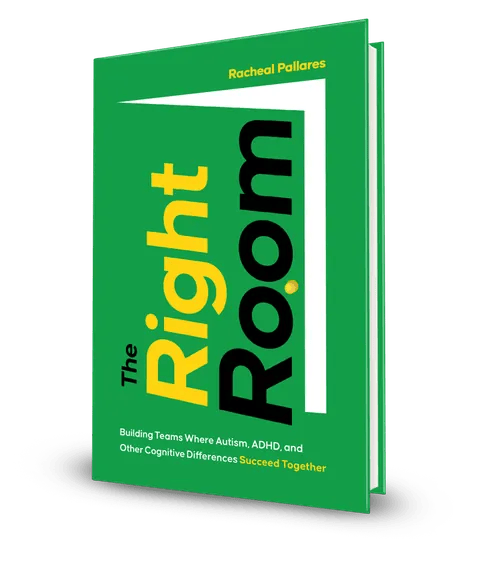
This comes from Chapter 10, Task Initiation.
The Right Room goes further, with the stories and tools behind it.
When the behavior is focus that drifts
Most people treat lost focus as a motivation problem. Sustained attention is regulated mostly by dopamine, an engagement signal that keeps asking whether a task has enough reward to keep going. In ADHD brains, lower dopamine receptor availability makes that signal less steady. The brain stays with work that is engaging, and importance alone rarely gets it there.
In Chapter 9 I teach four attributes that turn the signal back on: interest, novelty, urgency and challenge. A data analyst who goes flat on reconciliation reports engages when you tell her there is a pattern to find. “Before standup” is a harder deadline than “by end of day.” A personal best to beat turns a repetitive task into a game.
Then protect what is already moving. Motivation gets someone into a task, and momentum keeps them there. Most offices are motivation machines that do almost nothing to protect momentum, which is how a motivated person loses a whole morning to six unrelated interruptions. Body doubling helps here, and it costs nothing. Two people open a call and work quietly on their own things.
When the behavior is a big reaction to something small
Near the end of a big, stressful project, one where I had rolled with every pivot and shifted deadline, my manager handed out company polo shirts for a team photo. The material felt like sandpaper against my skin. I ended up crying on the bathroom floor, and I carried that moment with me for weeks.
The shirt was just the last straw. Emotional regulation draws on the same prefrontal system as attention, so under heavy cognitive load there is less left to soften a reaction. For ADHD brains, emotional dysregulation is woven into how the brain runs. Many people with ADHD have also spent years absorbing more corrective feedback than felt proportionate, so a small comment lands on top of everything that came before it.
“The person who seems to be falling apart over something small is showing you where their system finally ran out of room, not being dramatic.”
From Chapter 16, Emotional Regulation
The polo shirt answer was small. Moving the photo to next week would have cost about thirty seconds and a different plan. When you read ADHD behavior at work as overreaction, you miss the full system underneath it.
Some people on your team also feel unfairness faster and hold it longer. In Chapter 19 I share a framework I teach most of my private coaching clients: T-shirt, lotion, aspirin. A T-shirt injustice you can take off and set down. Lotion works into the skin and shapes how you show up for a while. Aspirin moves into everything. Naming the tier out loud helps. “This sounds like it’s more than a T-shirt right now” opens a door that “calm down” never will.
Strategies to manage ADHD behavior by changing the room
As I put it in Chapter 19, “You can’t manage someone’s sensitivity down, and trying to will only teach them to stop telling you things.” Trying to manage ADHD behavior by pushing on the person tends to go the same way. What you can change is the system around them.
Try this
- In your next one-on-one, ask which of interest, novelty, urgency and challenge helps each person stay in a task once they’ve started.
- When work stalls, ask “What’s your Zero Step?” and “Have you given it five minutes?” before you step in.
- Protect real blocks of time, with a team norm that a closed door or status light means come back later unless it’s urgent.
- Have the week-one conversation: what “too much” looks like for each person, how they like to receive feedback, and how they handle last-minute changes.
- Build in the pause, so anyone can say “Give me a day before I respond to this.”
Executive function isn’t only an ADHD struggle. Burnout, chronic stress, a new baby at home or caring for an aging parent can weaken it in anyone. The setup you build for the person with ADHD who is struggling now is the same one that carries your whole team when life gets heavy.
Questions about ADHD behavior at work
Is ADHD at work a motivation problem?
Usually not. Sustained attention is regulated mostly by dopamine, which signals whether a task has enough reward to keep going, and that signal fires less consistently in ADHD brains. Pressure and reminders leave it unchanged. Interest, novelty, urgency and challenge can turn it back on, and protected time keeps the work moving once it starts.
Why does someone with ADHD struggle to start tasks they know how to do?
Task initiation runs through the prefrontal cortex, and it gets harder to reach under cognitive load. The person understands the work, and the starting point just doesn’t fire on its own. A Zero Step, one small physical action like opening last month’s file, gets it moving. The Five-Minute Rule helps it stick.
Should I check in more often with an employee who has ADHD?
Checking in is a good instinct. The trap is when the check-in becomes the whole system and you turn into the starting point for every task. Keep checking in, and use that time to help the person find their own start, such as asking for their Zero Step instead of starting the work for them.
What should I do when someone reacts strongly to something small?
Meet it with quiet presence. Skip “What is wrong with you?” Later, when the person can talk, ask what would have made it easier and how to build that in before next time. The small thing is rarely the cause. It is usually the last item added to a system that was already full.
More questions this book answers
How to manage employees with ADHD
Managing autism at work: change the room, not the person
ADHD accommodations at work that actually help
Start with Chapter 1. It’s free.
The Recess Room, straight to your inbox.

