Managing autism at work: change the room, not the person
Searching for advice on managing autism at work? You care about getting this right, and the answer that works starts with the room around your employee: how clearly you ask for things and how you bring in change.
By Racheal Pallares, author of The Right Room. 5-minute read.
The short answer
Managing autism at work goes best when you work on the environment: say the actual ask plainly and give the reason before any change. The person was never the problem.
On this page
If you searched for help with managing autism at work, you probably have someone on your team you want to keep. That’s a good instinct. Let’s point it at the room they work in.
Where managing autism at work really starts
I’ve sat in a lot of performance reviews and one-on-ones where a manager is trying to figure out what to do with someone they genuinely like. The same phrases come up every time. Not good at communication. Gets distracted easily. Too sensitive. Doesn’t understand emotion. What those phrases describe is a cognitive difference showing up in a system that was never designed to hold it.
Take an empty coffee pot. Mark, prepping for a huge client meeting, found the pot empty, announced it to the room and walked away. Forty-five minutes later it was still empty, and he was furious. Alex, who has an ADHD brain, had heard him. Her filter sorted his comment as background, the same as someone saying the elevator is slow today. No task was assigned. No owner was named. To Mark, the signal was obvious. To Alex, there was no signal at all. Mark walked away deciding she was unreliable.
I was Alex once. Early in my career I was let go and told, in enough ways to make it land, that I couldn’t write. Two managers kept rewriting my emails in opposite directions, with no clear standard in the middle. I sat in the parking lot for an hour before I could drive.
“Nothing is wrong with them. The signal was unclear. The system was broken. And they got the blame.”
From Chapter 4, The Coffee Pot Is Empty
So before you look at the person, look at the signal. Was the ask clear? Did anyone own it? Asking those two questions is the first step in managing autism at work well.
Fit is something you build
I learned this on an audit team that turned over every six months. The company’s entire retention plan was pizza on Fridays.
The department had been hiring for availability and tolerance, people who could sit still and do repetitive work without complaining. The work actually needed people wired for precision, pattern recognition and deep focus in a structured environment. I pulled a small group of autistic candidates whose cognitive profiles matched the work. That profile doesn’t show up in every autistic person. When it does, it’s real and it’s measurable.
About two months in, a quiet woman who had barely said a word to me looked up and said, “Racheal, please stop checking on us. Stop bringing us pizza. I just want to go back to my files.” The work was hers. She had found the right room.
That team taught me that cognitive match is something you keep building, mostly through how you communicate and how you set up the work.
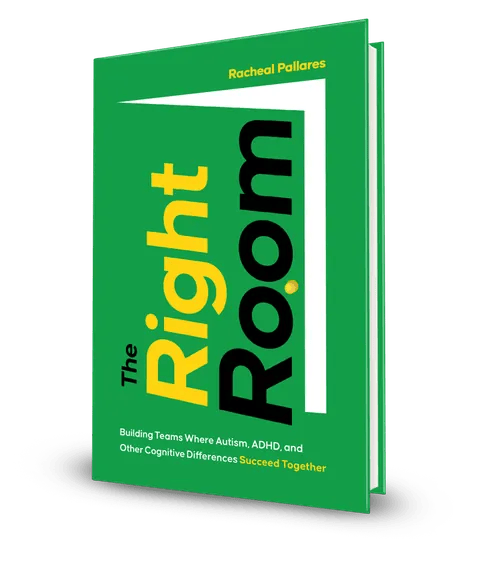
This comes from Chapter 4, The Coffee Pot Is Empty.
The Right Room goes further, with the stories and tools behind it.
Say the actual ask
In Chapter 13, a manager named Sarah wants her lead analyst, Mark, to simplify the technical slides in a client deck. She doesn’t want to sound like a boss barking orders, so she softens it into a suggestion to look at it “when you get a chance.”
Mark processes language literally. “When you get a chance” reads as optional, so he files it as low priority and goes back to his main task. On Friday the slides haven’t changed, and both of them are upset for reasons the other one can’t see.
Researcher Damian Milton called this the Double Empathy Problem. When two people process the world in different ways, they both struggle to read each other. In a 2020 study, autistic-to-autistic chains passed a story along just as well as neurotypical ones, while mixed chains lost more of it. The breakdown happened at the point where two styles met without a bridge.
“You can be completely kind and completely explicit at the same time. Direct isn’t mean.”
From Chapter 13, Double Empathy
The next Tuesday, Sarah tried again: “I need the technical slides simplified for Friday’s client call. It is the top priority this week. Can you flag me if anything gets in the way?” Mark said he would have a draft by Wednesday. Tell people how you communicate, and ask how they do, before a Friday deadline forces the question.
Give the why before the change
Priya, a project coordinator, got a message from her manager at 4:52 on a Friday: “Let’s regroup Monday, a few things changed on the Henderson account.” No detail. She spent the weekend running scenarios. On Monday she learned the client had moved one date, about twenty minutes of adjusting. She had carried it for sixty hours.
For many autistic brains, routine and planning are how a person stays ahead of a heavy load. When a plan changes, they have to rebuild everything they already prepared, and from the outside that can look like an overreaction. Research shows cognitive flexibility in autistic people improves when the environment is more predictable. You can build that predictability into how change arrives.
Lead with why before what. Give notice when you have it. You can say it out loud: “I know this is a shift, this is why it’s happening, and this is the time you have to adjust.” Making the why automatic is one of the most practical parts of managing autism at work.
Let people move so they can focus
For years I hid my hands under my desk. I focus better when I fidget, and my coworkers talked about it. My manager never pulled me aside. She bought a stack of cheap fidgets, dropped them on the conference room table and told the whole team that some people focus better with small movements. Twenty dollars and one honest sentence. Nobody was singled out.
Autistic brains often stim because they’re managing too much stimulation, and repetitive movement gives them a steady input they can control. Telling someone to stop takes away the tool their brain was using to focus and adds the work of holding it in. The person who looks distracted because they’re moving is often the most focused person in the room.
Try this
- Turn your next soft hint into a clear ask with a deadline, then add, “Is anything blocking you from hitting that deadline?”
- Before you send news of a change, ask yourself: Does my team know why this is changing? Do they have enough time to adapt before they need to act?
- Skip the “Can we talk Monday?” message at 4:55 on a Friday. Give the why up front or wait until Monday to send anything.
- Put a few cheap fidgets in the conference room and tell the whole team they’re there for anyone.
- Ask everyone on the team, “How do you communicate best?” and “Where does the system get in your way?”
Managing autism at work comes down to the environment you build for the whole team. Ask everyone how they work best. Everyone has an answer, and almost no one has ever been asked for one.
Questions about managing autism at work
How do you manage an autistic employee?
Start with how they work best, and ask them directly. How do you communicate best? What helps you focus? Where does the system get in your way? Then say what you need plainly, with a deadline and a reason. Keep it an ongoing conversation you return to, and ask the whole team the same questions.
Why do small changes hit some autistic employees so hard?
Many autistic people plan their whole day in advance to stay ahead of a heavy load. One small change can bring down that entire structure, so they rebuild it from scratch. Give advance notice when you have it, and lead with why the change is happening before you explain what changed.
Should I ask an employee to stop stimming or fidgeting?
No. Stimming is how the nervous system regulates itself, and it often helps people focus. Telling someone to stop takes away that tool and adds the work of suppressing it, which raises anxiety and cognitive load. Put fidgets out for everyone and stop treating visible movement as a performance problem.
Do I need to know if someone is autistic to support them?
No. The best changes work before anyone discloses anything. Clear asks, a reason before every change and fidgets on the conference table help the whole team. You probably already have people with autism or ADHD on your team who haven’t said so, because the environment never made it safe to.
More questions this book answers
What autism and ADHD look like at work
How to work as a team with ADHD
Strategies to manage ADHD behavior at work
Start with Chapter 1. It’s free.
The Recess Room, straight to your inbox.

