What autism and ADHD look like at work
Autism and ADHD at work rarely look the way people expect. They show up in an empty coffee pot, a long focus ramp, quiet masking and busy hands, and most of the friction comes from how the room was built.
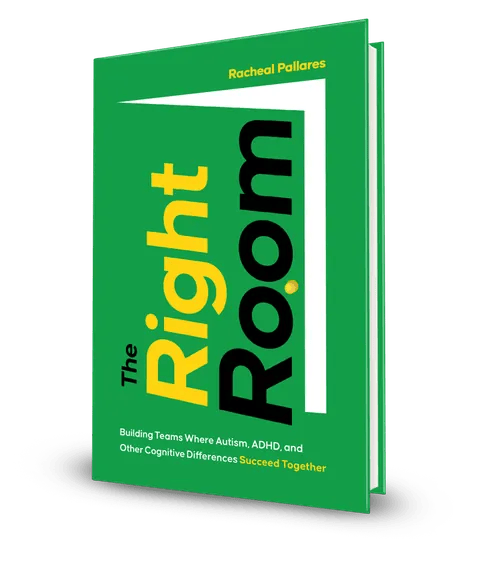
By Racheal Pallares, author of The Right Room. 5-minute read.
The short answer
Autism and ADHD at work usually look like ordinary friction, like a missed cue or a slipped deadline. Most of it comes from a workplace built for one standard brain, and changing the room lowers the load.
On this page
What do autism and ADHD look like at work?
Most of the time, autism and ADHD at work look like small, ordinary friction. Someone misses what felt like an obvious cue. A deadline slips on a task that seemed simple. A capable person keeps landing in the same conversation with their manager about the same problem, and nothing changes.
Then it gets a label. Not good at communication. Gets distracted easily. Too sensitive. Doesn’t understand emotion. I’ve heard every one of those phrases in performance reviews and hallway conversations. What they describe is a cognitive difference, the same moment read two different ways.
Take Mark and Alex. Mark had a big client meeting at two. At one o’clock he walked into the kitchen, announced that the coffee pot was empty, and walked away. Forty-five minutes later it was still empty, and he demanded to know why nobody had made a fresh pot. Alex, who has an ADHD brain, had heard him. Her brain filed his comment the way it would file “it looks like rain.” Nobody was named. No task was assigned. To Mark, the signal was obvious. To Alex, there was no signal at all.
Neither of them was doing their job badly. The room was built around what the book calls the standard brain, one that hears a verbal update once, holds onto it without writing anything down, and reads every unspoken expectation the same way. That brain doesn’t exist. Autism diagnoses have gone from one in 150 children to one in 31 in a single generation, and ADHD affects about 6 percent of adults. The number of people whose brains work differently has held steady. We finally started seeing them.
“The employee struggling in your current environment is showing you the curb cut you’ve not built yet.”
From Chapter 3, The Standard Brain Doesn’t Exist
Why does the same moment land so differently?
A lot of what gets misread about autism and ADHD in the workplace comes down to processing direction. Top-down processors start from the goal and filter out whatever doesn’t serve it. They move fast and can miss small details. Bottom-up processors start from the raw data and can’t move forward until every piece checks out. They are precise, and precision takes time.
Autistic people often lean toward detail and raw sensory input, though not every autistic person processes this way. ADHD brings less consistent top-down filtering, which leaves the brain more open to interruption. These are tendencies. Many people carry both, and many shift with energy and environment. What research does show is that many of these brains carry a higher cognitive load because of how they process.
Focus works the same way. It’s a ramp, and different brains need different lengths of track. My own ramp to deep focus is thirty to forty-five minutes. When I shared an office with Kevin, a great guy whose brain ran on quick questions and conversation, every interruption reset me. By noon I had been at my desk for four hours and nothing was done. Then I started working after everyone else went to bed, and I tore through problems that had stumped me for days. I wasn’t smarter. I was just uninterrupted.
ADHD attention is interest dependent. The same person who can’t stay with a required training document for four minutes may spend six hours absorbed in a problem they find interesting. Across autistic and ADHD populations, researchers found hyperfocus and inattention both elevated and linked. The brains that go deepest are often the ones that struggle most when conditions are wrong.
What is masking, and why don’t managers see it?
Everyone rehearses for a job interview. You sit up a little straighter and smile a little more, and when you walk out, you put it down. Masking is what happens when you never get to put it down. Every hallway chat, client call and Slack message gets interview-level preparation, all day.
For many people with autism and ADHD at work, masking looks like reading an email six times before sending it, forcing eye contact, scripting hard conversations in advance, and saying “I’m fine” while already overwhelmed. From the outside, it looks like professionalism.
“It is a full-time job running invisibly on top of the actual full-time job. And nobody sees it, because it’s working.”
From Chapter 12, Masking
The cost shows up later. Someone snaps at home over something small. A steady performer resigns with no warning. The signals were usually there in exhaustion, withdrawal, extra sick days and a slight fade in the work, and they got read as professionalism instead of distress. The real test comes straight from the interview. Does it ever get to stop?
This comes from Chapter 12, Masking.
The Right Room goes further, with the stories and tools behind it.
Is fidgeting a problem for ADHD and autism at work?
For years I hid my hands under my desk. I’m a fidgeter. Rolling a pen or tapping two fingers keeps one part of my brain busy so the rest of me can focus. In one of my first corporate jobs, coworkers talked about it. My manager heard them. She bought a stack of cheap fidgets, dropped them on the conference room table, and told the team that some people focus better with small movements. Twenty dollars and one honest sentence. No meeting, no disclosure, nobody singled out.
Fidgeting is one of the most visible signs of ADHD and autism at work, and everyone does a version of it. The pen you click and the leg you bounce count too. ADHD brains are often under-stimulated, so movement keeps them engaged with the task. Autistic brains are often managing too much input, and repetitive movement gives them something steady and controllable. Both are the brain doing exactly what it needs to do to work.
Telling someone to stop removes the tool their brain was using to focus and adds the work of suppressing it. Concentration gets harder, and shame gets added to the process.
What can managers change about autism and ADHD at work?
Supporting autism and ADHD at work starts with where you look. The person struggling most in your current system is showing you where it breaks for everyone, just less visibly. So ask. How do you communicate best? What helps you focus? Where does the system get in your way? Ask the whole team, and keep coming back to it. Most people have never been asked.
Try this
- Protect two to three hours of uninterrupted time, then put collaboration in its own window afterward.
- Write expectations down, and define what done means before the work starts.
- Make clarifying questions safe. Notice what your face and tone do when someone asks one.
- Give processing time before you expect an answer, and measure output instead of presence.
- Put fidgets on the conference room table before anyone has to ask.
None of these cost much. Each one lowers the load on the people carrying the most, and the rest of the team gets a clearer room too. You aren’t managing performance. You are managing the conditions that make it possible.
Questions about autism and ADHD at work
What does AuDHD at work look like?
AuDHD means having both autism and ADHD. Before 2013, you couldn’t be diagnosed with both, because they were considered mutually exclusive. In one major study, 70 percent of autistic children also had at least one other condition, like ADHD. At work, research across both groups found hyperfocus and inattention elevated together, so deep focus and hard days can show up in the same person.
Do I have to disclose autism or ADHD to get what I need?
You don’t owe anyone an explanation for how your brain works. You can name the need without clinical language. Saying “I do my best work in longer uninterrupted blocks” is a normal performance conversation. The same goes for saying you focus better with something to do with your hands. Most people won’t think twice.
How can I tell if someone on my team is masking?
Usually you can’t see it directly. Masking hides behind good work and a calm face. Watch for exhaustion, withdrawal, more sick days and a slight fade in quality. Better yet, ask in a regular one-on-one: “What would make this easier for you, even if nothing looks wrong from where I am sitting?” Ask it long before an exit interview.
Why do people with ADHD seem distracted at work?
For an ADHD brain, the environment often has more competing inputs than the attention system can filter. A task also needs a hook, like a deadline, a direct ask or a reminder, or it gets filed as background. What looks like distraction is a brain working the way it was built, in a room that was never built for it.
More questions this book answers
How to work as a team with ADHD
Managing autism at work: change the room, not the person
ADHD accommodations at work that actually help
Start with Chapter 1. It’s free.
The Recess Room, straight to your inbox.

